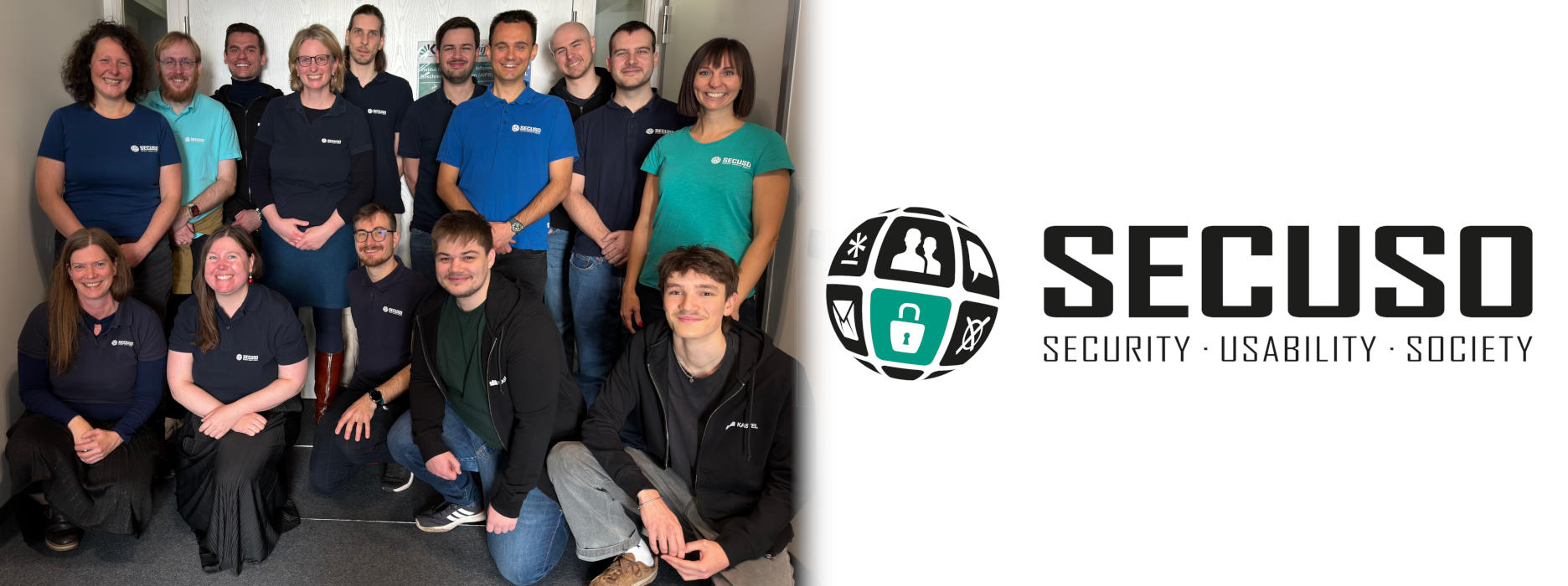
The research group SECUSO (Security • Usability • Society) belongs to the Institute of Applied Informatics and Formal Description Methods (AIFB) of the Karlsruhe Institute of Technology (KIT). The group was founded in 2011 by Prof. Dr. Melanie Volkamer at the TU Darmstadt. SECUSO moved to the Karlsruhe Institute of Technology at the beginning of 2018. SECUSO is a member of Kastel, K-CIST and KD²Lab.
On Friday, October 9, KIT spark—a new research infrastructure—will open at Kronenplatz. SECUSO and the citizen panel “Wir forschen digital” are also involved: In the future, researchers will be able to conduct studies with members of the citizen panel in a glass meeting box.
KIT spark will be open to the public for the first time on October 10 and 11, coinciding with the Reallaborfestival and the Karlsruhe City Festival. We invite everyone interested to stop by! In the meeting box, you can try out “Wir forschen digital” firsthand and participate in a mini-study on QR code phishing. There’s also plenty to see and do at Kronenplatz: Learn more about “Wir forschen digital,” spin the wheel of fortune, and with a little luck, win one of our prizes!
Drawing on recent research, SECUSO has developed a step-by-step guide for the upcoming 2026 GI Presidium election. It takes voters through the process of casting and verifying their votes. An earlier version of the guide was evaluated in a large-scale user study published at CHI 2026. The guide can be explored before the election.
Read the guideWe congratulate Florian Moser on his appointment as a GI Junior Fellow for 2026! We are pleased that the German Informatics Society (GI) accepted our recommendation and appointed Florian Moser as one of five Junior Fellows. Florian’s research focuses on the security of online elections. He has collaborated with SECUSO on several joint projects and publications, including the paper "Development and Expert Evaluation of an Informative Video concerning Verifiable Internet Voting" by Tobias Hilt, Florian Moser, Philipp Matheis, and Melanie Volkamer, which won the Distinguished Paper Award at last year's International Conference for Electronic Voting (EVote ID 2025).
Read the press releaseIn a statement released by the Science Media Center Germany (SMC), Melanie Volkamer commented on the settlement reached in the lawsuit filed by several U.S. states against Meta. Among other things, the settlement includes that an age verification system must be implemented. Since the specific measures for age verification have not yet been clearly defined in the settlement, it is not possible to assess them in terms of effectiveness and data protection. However, according to Melanie Volkamer, a review of potential verification systems in the European context reveals that no satisfactory solution has yet emerged. She cites zero-knowledge proofs as a potential technical solution for age verification that complies with data protection regulations. The statement was prepared in collaboration with Yorick Last. Among others, the comments were featured in “Der Standard,” which reported on the case.
Read the article